Start with the seating application
The application decides almost everything else, so describe where the cushion will be used before discussing construction. An office chair needs a stable, low-profile cushion that does not lift the user away from the backrest; a car or truck seat needs a shape that survives constant pressure changes and a surface that grips the seat. Motorcycle cushions are usually narrower, with a contour that follows the saddle and a valve placed where a rider can reach it. A wheelchair cushion carries different expectations: pressure distribution, positioning and skin contact matter more than comfort alone, and buyers often ask for a custom air cushion that matches an existing seat pan. Lumbar supports sit in a category of their own, because the bladder is loaded against the lower back rather than sat on. Write the use case in one sentence and keep it with the drawing.
Bladder structure and chamber layout
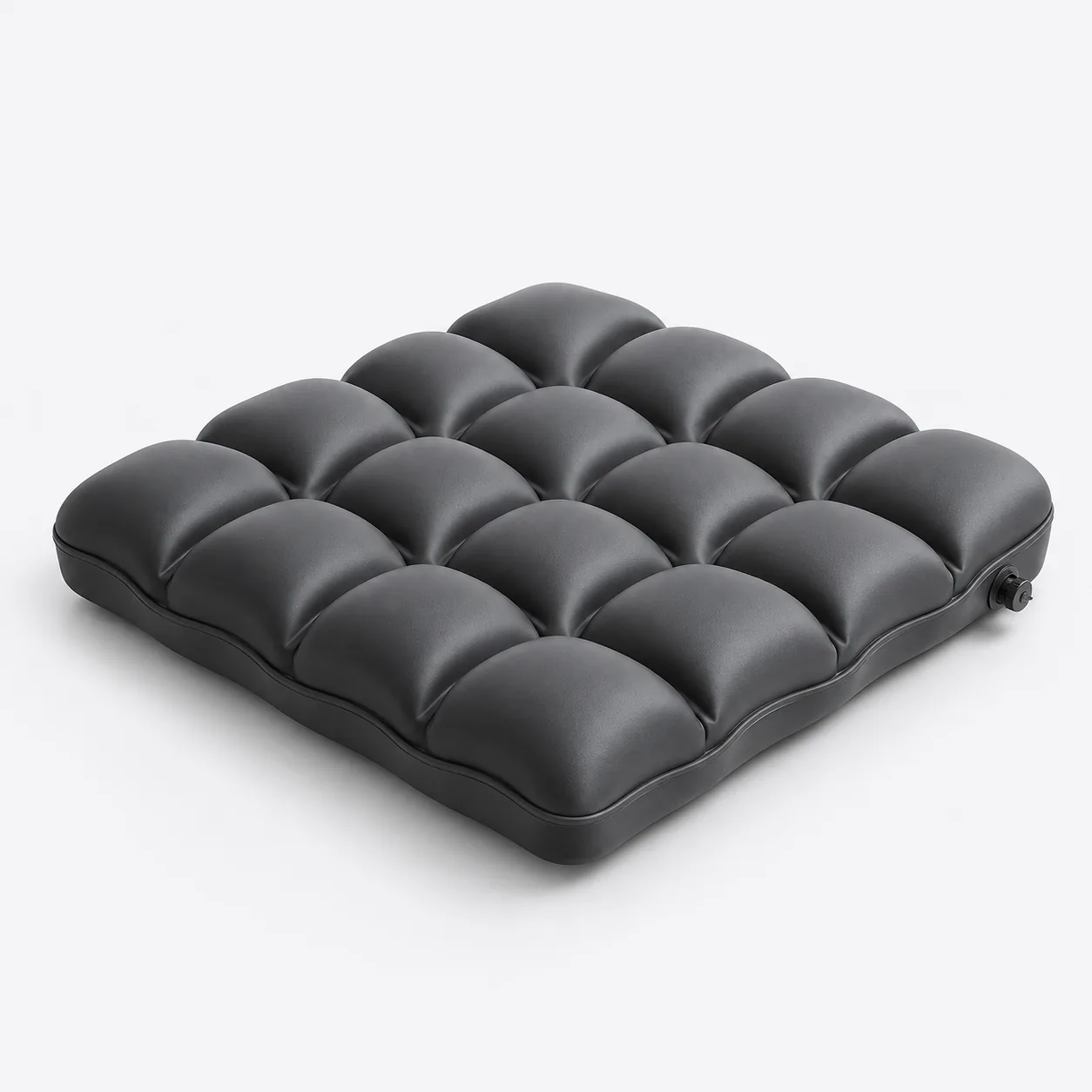
Inside the cover, a cushion is a set of chambers rather than one air space. A single chamber is simple and inexpensive to make but lets air move away from the loaded point, so the user sinks where pressure is highest. Connected chambers, formed by internal welds or baffles, hold the air in place and give a more even surface; independent chambers allow separate inflation, which suits positioning products and adjustable seats. We review the layout with you against the body contact area, the cover seams and the way the product folds for storage. As an inflatable cushion manufacturer we build the chamber pattern into the drawing, so weld positions, channel widths and overall thickness are agreed before a sample is cut.
Material and thickness choices
Most of our cushions use TPU film, either alone or laminated to a fabric backing. Plain TPU is flexible, easy to clean and can be welded into complex shapes, which suits office, car and lumbar cushions. TPU composite fabric adds dimensional stability and a softer hand, and it takes printing or a flocked surface better, so it is common on wheelchair cushions and on products sold with a visible cover. Thickness is a balance: a heavier film resists punctures and holds pressure longer, while a lighter film conforms more readily and feels less stiff under the user. We confirm the film weight, the backing and the surface finish against your sample, then keep those values on the specification. If the cushion must fit inside an existing cover, send the cover so we can check clearance.
Valves and inflation method
The valve is the part users touch most, so it should be chosen together with the inflation method. A screw valve suits products inflated once at home; a push-in valve is faster for retail and rental products that are inflated and deflated often; a two-way valve lets the user adjust firmness while seated. For medical and wheelchair cushions we often review a valve that can be operated with limited hand strength, and we confirm its position so it does not press into the user or catch on a cover. Hand pumps, built-in pumps and mouth inflation each set different requirements for the valve bore and the hose connection. Tell us how the product will be inflated in the market, and we will match the valve to that method.
Dimensions, support and fit
Give the seat dimensions the cushion must fit, not only the cushion size you have in mind. We review the flat pattern against the inflated shape, because a cushion that measures correctly on the table can still overhang or ride up once it is filled. Seat depth and width decide the contact area, while the height of the inflated cushion decides whether the user still reaches the floor or the pedals. On a wheelchair cushion the seat pan, the side rails and any positioning hardware all constrain the outline, and we check the inflated thickness against the chair's balance. We confirm the tolerance on the finished size during sampling, since welding and material stretch both affect the final measurement.
Cleaning, durability and sample approval
Ask how the cushion will be cleaned before the cover and the film are fixed, because wiping with a hospital disinfectant and washing by hand are different requirements. Smooth TPU wipes down easily, while a fabric face needs a removable cover or a finish that tolerates the cleaning agent named in your specification. Durability comes from the seam, the valve seat and the film thickness more than from the outer cover, so we inspect all three on the sample. We confirm the cycle you expect, such as repeated inflation, static load or a drop test, and record the result on the approval sheet. Sampling is where these points are settled: we make the part to the agreed drawing, you test it in the real application, and any change is written into the specification before production. Nothing should reach the production line on a verbal agreement.
Information to include in an inquiry
For seating and support options by application, see our inflatable air cushions and support products.
A clear inquiry shortens the sampling round. Send the application and the seat or product the cushion fits, the outline drawing with flat and inflated dimensions, the expected user weight and the chamber layout you have in mind. Add the material and surface finish, the valve type and position, the cover if there is one, the target quantity and the market you sell into. If you already have a sample, a photo with a ruler beside it is more useful than a paragraph of description. Tell us which standards or customer requirements apply, and we will confirm what we can support. With those details we can quote, propose a construction and schedule a sample without a second round of questions.
Send your cushion requirements and we will confirm the construction, valve and sampling plan.